
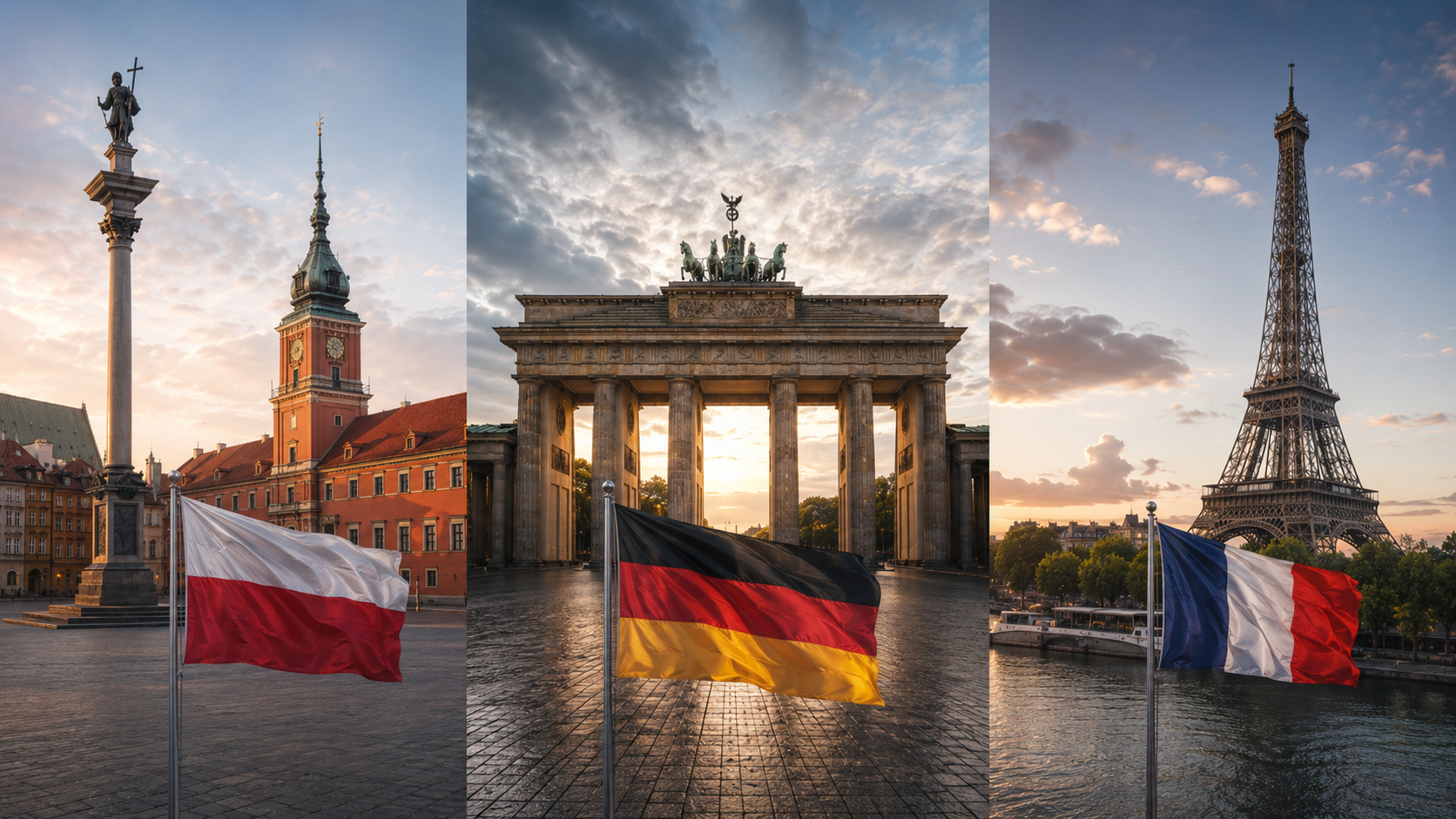
Péter Magyar’s first major European trips were more than diplomatic introductions. Warsaw, Berlin and Paris together formed a clear foreign-policy message: Hungary wants to return to the European mainstream after years of isolation, veto politics and distrust.
Each capital carried a different meaning. Warsaw was about repairing a historic alliance. Berlin was about restoring predictability with Hungary’s most important economic partner. Paris was about proving that Budapest does not only want to rejoin Europe, but also take part in shaping it.
The real subject of the tour was trust.
By the end of the Orbán era, Hungary was widely seen as an unpredictable actor: close to Moscow, hostile toward Kyiv, confrontational in Brussels and ready to use vetoes as leverage. Magyar’s task was to show that Budapest’s influence would no longer come from obstruction, but from reliability.
Warsaw: Repairing a Historic Bond
The Polish visit began with a symbolic gesture. Magyar and his delegation laid a wreath at the memorial of Henryk Sławik and József Antall Sr., who helped rescue Polish refugees, including Jews, during the Second World War. The message was clear: the new Hungarian government wants to rebuild relations with Poland on historical and moral foundations, not short-term political convenience.
Donald Tusk then received Magyar in Warsaw with military honours. The two leaders held talks while Hungarian ministers met their Polish counterparts. The programme later continued in Gdańsk, where Magyar met Lech Wałęsa — a deliberate stop in the city that became the symbol of Solidarity and democratic resistance.
The Polish leg was therefore not just protocol. It placed Hungary back inside a Central European memory shaped by freedom, sovereignty and the experience of Russian domination.
That is why Ukraine was the key issue behind the visit. Hungarian-Polish relations deteriorated during the Orbán years largely because of Budapest’s position on Russia’s war. For Warsaw, Ukraine is not a distant geopolitical question but a direct security concern.
Magyar’s message was that the old ambiguity toward Moscow is over. His call to revive the Visegrád cooperation also fit this logic: the V4 can regain relevance only if it is no longer paralysed by disagreement over Russia.
Berlin: The Test of Predictability
Berlin carried a different weight. Germany is not only a political centre of the EU, but one of Hungary’s most important economic partners. German industry is deeply embedded in the Hungarian economy, so political distrust has direct economic consequences.
Friedrich Merz received Magyar at the Chancellery with military honours. Their talks focused on bilateral relations, Ukraine, European policy and Euro-Atlantic security. Berlin’s expectation was simple: normalisation.
Germany wants Hungary to stop being a recurring obstacle in the EU and NATO. No reflexive vetoes, no special ambiguity toward Moscow, no turning European decisions into domestic political theatre.
Magyar also signalled a shift on Ukraine. He said he was ready to meet Volodymyr Zelensky once technical talks on the rights of the Hungarian minority in Transcarpathia were concluded. The minority issue remains on the table, but the tone has changed: it is now presented as a subject for negotiation, not as a tool for blocking.
That was the point of the Berlin visit. Hungary was not asked to abandon its interests. It was asked to pursue them without paralysing European unity.
Paris: Seeking a European Role
Paris added a third layer. If Warsaw was about memory and Berlin about predictability, Paris was about strategy.
Emmanuel Macron received Magyar at the Élysée Palace. Their talks covered Ukraine, EU funds, strategic cooperation, economic ties and security policy. Magyar also met the leaders of the French National Assembly and Senate, turning the visit into broader political bridge-building.
France matters because Macron has long argued for European strategic autonomy: stronger defence, greater continental capacity and less dependence on outside powers. For Hungary, this is a sensitive but important opening. Under Orbán, Budapest was often seen as a separate-track actor. In Paris, Magyar tried to show that Hungary wants to be part of Europe’s strategic conversation, not merely return to the table.
Energy is part of that calculation. Hungary remains heavily dependent on Russian energy, and any serious foreign-policy shift will be judged partly by whether that dependence can be reduced. France, especially through nuclear cooperation, could become an important partner.
Paris therefore turned the return into a larger question: can Hungary move from being Europe’s problem case to being a serious participant in shaping the continent’s future?
Three Capitals, One Test
The three visits asked Hungary three different questions.
Warsaw asked where Budapest stands in Russia’s shadow.
Berlin asked whether Hungary can again be a stable EU and economic partner.
Paris asked whether Hungary has a serious vision for Europe’s future.
Magyar answered all three with the same basic claim: the era of obstruction is over. Hungary wants influence through reliability, not disruption.
That is a harder path. Vetoes are loud, fast and easy to sell at home. Trust is slower, less dramatic and easier to lose.
The Probation Period Begins
The tour opened doors, but it did not settle anything.
On Ukraine, Budapest must prove that minority rights will not again become a blocking strategy. In the EU, it must show that the veto is no longer a reflex. On rule-of-law reforms, it must demonstrate that the Western opening is not just diplomatic language. On energy, it must turn diversification into policy.
Hungary was welcomed in Warsaw, Berlin and Paris. But it will also be watched.
The country has signalled that it wants to return to Europe. The real test now is whether it can stay there as a reliable partner.